

Archangel Uriel: The Angel Who Shows You What You’re Missing
Archangel Uriel is often described as the angel of wisdom or illumination. Those titles are useful, but they can make his current sound much softer and more abstract than it actually is. Uriel does not simply hand out inspired ideas. In the older texts, he explains how things are ordered, shows human beings where their understanding has failed and reveals structures that normally remain beyond ordinary perception.
This is the aspect of Uriel I find most useful in magical work. I approach him when I have reached the limit of what I can figure out by thinking about a problem in the same way. Sometimes information is missing. At other times, all the information is already there and the real problem is that I am looking at it through a bad assumption. Uriel is particularly good at exposing that difference.
His older appearances support this very strongly. In 1 Enoch, Uriel guides Enoch through the workings of the heavens and explains the courses of the sun, moon and stars. In 2 Esdras, he answers Ezra’s enormous questions about suffering and divine justice by first demonstrating how little Ezra understands about the world directly around him. The Grimoire of Armadel later gives Uriel authority over natural sciences and medicine while connecting his character with the purification of the understanding.
So Uriel’s illumination is not merely a flash of light, it is the point where underlying order of things becomes.
Uriel Comes From Outside the Usual Biblical Canon
Unlike Michael and Gabriel, Uriel is not named as an angel in the canonical Hebrew Bible or the standard Protestant and Catholic biblical canons. His most important early appearances survive in Jewish apocalyptic literature, particularly 1 Enoch and the text usually called 2 Esdras or 4 Ezra.
This matters because Uriel’s surviving character is shaped heavily by that apocalyptic world. He is not introduced merely as a guardian assigned to an individual person. He appears in visions dealing with the architecture of creation, the fate of the world, divine judgment and the limits of human knowledge.
The Jewish Encyclopedia’s entry on Uriel preserves some of this older complexity. It discusses him as one of the great angels surrounding the world and notes traditions connecting him with fire, judgment and the instruction of Ezra.
I think this background is essential before trying to understand later occult correspondences. If we begin with the modern idea that Uriel simply means Earth, North and wisdom, most of the older material becomes difficult to explain. If we begin with the angel who reveals the hidden order of creation, the later magical developments make much more sense.
Uriel Shows Enoch How the Heavens Actually Work
The most impressive Uriel material in 1 Enoch appears in the astronomical portion of the text. Enoch is not simply shown a beautiful heaven. Uriel explains its machinery.
The Book of the Courses of the Heavenly Luminaries in 1 Enoch describes Uriel as the holy angel who guides Enoch through the laws governing the sun and moon. He shows him their courses, their gates, their periods and the reckoning of the year. The text repeatedly presents Uriel as the angel who knows how these celestial movements are organized and can explain them to a human observer.
This is a much more precise kind of wisdom than simply knowing many things. Uriel reveals systems.
That distinction has become central to the way I work with him. If I am studying a difficult occult system, I am rarely satisfied with memorizing correspondences. I want to understand why the parts have been arranged that way, what connects them and what changes when one piece of the system is moved. Uriel is extremely appropriate for this type of work because the Enochic Uriel teaches by revealing relationships.
This also makes him particularly useful with grimoires and older magical texts. Many of them assume knowledge they never explain properly. A diagram may suddenly appear without enough commentary. A list of names may belong to an underlying structure that becomes obvious only after comparing several sections. When I approach Uriel during that sort of study, I am asking for the organizing principle rather than another isolated fact.
The same approach applies outside occultism. If I am faced with a complicated problem, Uriel is useful when I need to see how the pieces affect one another. Understanding the structure often makes the next decision much easier without requiring some dramatic supernatural prediction.
Uriel Also Warns Noah Before the Flood
1 Enoch gives Uriel another role that is easy to overlook. Before the Flood, God sends him to warn Noah that destruction is approaching and to instruct him so that he and his descendants can survive it.
The passage appears in 1 Enoch, chapter 10. Uriel is told to reveal what is coming before the event reaches the rest of the world.
This adds another dimension to his knowledge. Uriel does not reveal information simply because hidden information is interesting. The revelation has practical consequences. Noah is shown enough of the coming situation to act before it is too late.
I keep this in mind when approaching Uriel about decisions. The useful answer is not always a prediction of exactly what will happen. Sometimes it is enough to recognize a pattern early enough that I can respond intelligently. There is a major difference between wanting supernatural certainty and wanting enough understanding to avoid walking blindly into an obvious consequence.
The Angel Over the World and Tartarus
Modern representations of Uriel usually emphasize wisdom and light, but 1 Enoch gives him a far more severe office as well. In its list of the seven holy angels, Uriel is described as the angel who is over the world and over Tartarus.
You can read the passage directly in 1 Enoch, chapter 20.
This matters because it prevents Uriel from becoming a harmless patron of study. The same angel who explains the movements of the heavens also knows the places where rebellious powers are confined. Earlier in the Enochic journey, Uriel explains the fate of angels who violated the divine order.
Knowledge and judgment are therefore much closer together in Uriel than modern material often suggests. To understand how something is ordered is also to recognize when it has departed from that order.
I find this relevant when working around deception or self-deception. Uriel does not merely add more information to a confused situation.
His current can make contradictions increasingly difficult to maintain. A story may have sounded plausible until one missing fact is placed beside it. Once the actual structure becomes visible, the false version often collapses without requiring much further argument.
Uriel Does Not Give Ezra an Easy Answer
If I had to choose one text that best explains why I work with Uriel for wisdom, it would probably be 2 Esdras.
Ezra is trying to understand enormous questions. He wants to know why the world contains so much injustice and why God’s people suffer while corrupt powers prosper. Instead of giving him a neat theological explanation, Uriel challenges the capacity of the person asking the question.
In 2 Esdras 4, Uriel asks Ezra to do things such as weigh fire and measure a blast of wind. Ezra admits that he cannot. Uriel then points out the obvious problem: if Ezra cannot fully understand things that belong to his own world, why does he assume that the entire order of the Most High should be immediately comprehensible to him?
I like this Uriel much more than the modern angel who simply whispers the correct answer into someone’s mind.
He teaches intellectual humility without demanding stupidity. Ezra is not told to stop asking questions. Uriel continues teaching him through visions and explanations. What changes is Ezra’s relationship with the question. He has to recognize the limitations built into his own viewpoint before he can understand anything larger.
This is extremely useful in magic because occult practice makes self-deception easy. A strong expectation can be mistaken for intuition. A symbolic experience can be interpreted too literally because the magician wants it to confirm something. Uriel’s current is valuable precisely because it can interrupt that process.
I do not approach him to make myself feel more certain. I approach him when I want my certainty tested.
Does Uriel Mean “Light of God” or “Fire of God”?
Uriel’s name is commonly translated as either Light of God or Fire of God. Both forms have circulated widely, and older scholarship does not completely agree about which derivation should be preferred.
The Jewish Encyclopedia, interestingly, argues for a fiery interpretation and connects Uriel with traditions of divine fire and judgment. Other reference traditions render the name as “God is my light.”
I do not think much is gained by pretending that the ambiguity does not exist. Both images suit important parts of the tradition.
Light reveals. Fire changes what it touches.
Uriel’s wisdom often does both. Genuine understanding can illuminate a problem, but once something has been understood clearly enough, it can become difficult to continue behaving as if that knowledge does not exist. The revelation produces consequences.
This is one reason I prefer Uriel for knowledge that needs to become useful. I am less interested in collecting occult information than in reaching the point where the information changes how I work.
How Uriel Became the Archangel of Earth and the North
Many ceremonial magicians know Uriel, often spelled Auriel, as the Archangel of Earth standing in the North. This is the arrangement used in the later Pentagram tradition and it has become one of his most familiar occult identities.
In the Lesser Ritual of the Pentagram, the magician invokes Raphael before him, Gabriel behind him, Michael at the right hand and Auriel at the left. With the magician facing East, Auriel occupies the North. The later elemental structure places Earth there.
This attribution gives Uriel a very useful practical dimension. Earth is where understanding has to become concrete. A theory that never changes action remains a theory. A magical insight that cannot survive contact with ordinary life may not have been understood as deeply as the practitioner imagined.
I use the Earth current when I already know enough and the real problem is application. This is particularly useful when I have spent too much time researching, planning or thinking and need to reduce everything I have learned to something that can actually be done.
This aspect also aligns closely with the Uriel prayer work I use. One of the easiest traps in occult study is endless preparation. Uriel can be excellent for identifying which knowledge is actually necessary and which has become a sophisticated way of avoiding action.
But Uriel Was Not Always Placed in the North
The North-Earth arrangement should not be projected backward onto every older magical source.
Agrippa’s Three Books of Occult Philosophy, Book II presents a fourfold scale in which Michael, Raphael, Gabriel and Uriel correspond respectively with the East, West, North and South. In the same arrangement, Uriel occupies the Earth position.
Book III makes the directional attribution even clearer, naming Nariel, whom Agrippa says some call Uriel, over the Southern wind. You can see that material in Occult Philosophy, Book III.
So Earth remains strongly associated with Uriel, but the direction changes. Agrippa gives Earth to Uriel while placing him in the South. The later ceremonial system keeps the Earth correspondence and moves him to the North.
I treat these as different ritual architectures rather than trying to manufacture one timeless correspondence chart. If I am using the later elemental system, Uriel belongs in the North. If I am deliberately working from Agrippa, I follow Agrippa’s structure.
The fact that the direction changes is itself useful. It reminds us that Uriel’s identity is much older and wider than his position in one familiar banishing ritual.
Uriel or Auriel?
The spelling Auriel appears frequently in later Western ceremonial magic, particularly in Golden Dawn-derived material. In that context, Auriel and Uriel refer to the same archangel rather than two separate beings.
I normally use Uriel when discussing the older Jewish and apocalyptic material because that is the form most readers recognize from 1 Enoch and 2 Esdras. When quoting or working directly from a ceremonial system that uses Auriel, I keep the spelling used by that system.
This may seem like a small point, but it becomes useful when researching older occult books. Someone searching only for Uriel can easily miss material filed under Auriel or Oriel.
The Uriel of the Grimoire of Armadel
The Grimoire of Armadel contains some of the best magical material on Uriel because it connects his older identity as Ezra’s teacher with a much broader field of practical knowledge.
In the section titled In the Fields of Babylon, Armadel says that Uriel revealed prophecy to Esdras and aided the children of Israel in Babylon. It then gives him an unusually concrete teaching office: Uriel teaches natural sciences, physic and medicine. The text says he should be invoked on Wednesday before daybreak and gives a specific character for him.
You can read the Uriel passage from the Grimoire of Armadel here.
This is one of the places where the older Uriel becomes particularly relevant to a magician. Armadel is not presenting him merely as an abstract patron of wisdom. His knowledge includes the workings of the natural world.
The explanation attached to the sigil goes even further. It concerns the purification and elevation of the faculties of mind and understanding, eventually leading into the comprehension of spirits. That fits the Uriel of Ezra extremely well. Knowledge begins with correcting the mind that is trying to know.
I find this one of the most convincing historical foundations for approaching Uriel during serious study. His office is not just obtaining facts from somewhere outside myself. Part of the operation concerns improving the faculty doing the understanding.
Uriel’s Sigil in the Grimoire of Armadel
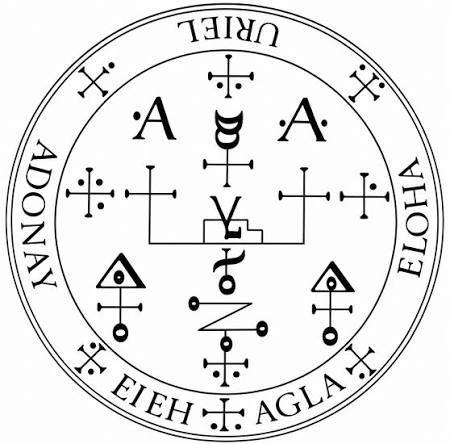
The best historical Uriel character I would use for direct work is the one preserved in the Grimoire of Armadel.
I prefer this character precisely because the source tells us what it is connected with. Uriel is presented as a teacher of natural knowledge whose sigil concerns the refinement of understanding. That gives me an actual magical context for the symbol rather than a modern design carrying his name.
I would use it when the work concerns difficult study, occult knowledge or the need to understand a spiritual problem more clearly. It also makes sense for work involving the comprehension of spirits because Armadel itself places that idea within the teaching attached to the character.
I would not assume every geometric symbol sold online as a “Uriel sigil” has the same history. When I can trace a character to a grimoire and understand what that grimoire says about it, I have a much better reason to use it.
What I Actually Ask Uriel For
Most of my work with Uriel begins with a problem I cannot properly understand.
Difficult occult study is an obvious example. If I have read the same material repeatedly and still feel that I am merely remembering words, I may approach Uriel before returning to it. What I want is not easier material. I want the principle behind the material to become clear enough that I can work with it independently.
I also find him useful before important decisions where the visible choices are misleading. A decision can look attractive because I am focused on its immediate benefit while ignoring the cost that follows later. Uriel is well suited to exposing that kind of distortion.
Hidden motives fall into the same territory. When someone’s behavior and explanation do not match, I do not necessarily need clairvoyance about the contents of his mind. Often I need to recognize the contradiction I have already noticed and stop explaining it away. Uriel’s current can be very useful there.
There is also a place for Uriel in divination, although I approach him differently from Gabriel. With Gabriel I am more interested in receiving and interpreting symbolic material. With Uriel I want the reading to expose the structure of the problem. I may ask what assumption I am making that prevents the situation from making sense.
Prayer to Archangel Uriel
Prayer works particularly well with Uriel because much of his traditional role is instructional. A full ceremonial operation is not necessary every time I want clarity about something. Sometimes the most useful approach is to state the problem clearly, address Uriel directly and then leave enough mental space for the answer to develop.
I have a separate collection of prayers to Archangel Uriel for wisdom, hidden knowledge and illumination. Those prayers cover several situations in which I actually use his current, including difficult study, important decisions and the exposure of concealed motives.
There is also a prayer specifically for the point where knowledge needs to become action. I consider that especially appropriate to Uriel’s later Earth correspondence. Understanding something intellectually is only the beginning. Eventually the knowledge has to affect what I do in practice.
What Uriel’s Presence Is Like for Me
I do not experience Uriel as a particularly sentimental current. There is a stillness to the work, but I would not describe it as comforting in the ordinary sense. The effect is more like intellectual pressure being applied to a weak point in an argument.
Something that previously seemed complicated may suddenly look simpler because one assumption has dropped away. At other times I notice that a question I was obsessing over was badly framed from the beginning. The answer could not appear because I was demanding an answer to the wrong question.
This is one of the reasons I keep a notebook nearby when working with Uriel. The useful result may be an idea or a connection that initially seems almost mundane. If I dismiss it because I expected a dramatic vision, I can easily miss the entire point of the operation.
I also find that Uriel can be severe toward intellectual vanity. It is easy to accumulate occult terminology and mistake vocabulary for understanding. His current does not reward that very much. If I cannot explain a principle plainly or apply it to actual practice, I usually assume I have more work to do.
Uriel Is Especially Useful When You May Be Wrong
There are angels I am comfortable approaching when I already know exactly what I want. Uriel is often more valuable when I am willing to admit that my understanding of the situation may be the problem.
This makes him particularly useful when emotions have hardened around a conclusion. Sometimes I become attached to an interpretation because changing it would force me to change a plan. In that condition, simply gathering more information tends to produce selective reading. I notice whatever supports the conclusion and explain away whatever does not.
Uriel is the angel I would call when I want that process interrupted.
The lesson of Ezra is useful here. Ezra asks serious questions, but Uriel does not flatter him for asking them. He forces him to confront the limits of the mind asking.
I consider that one of Uriel’s greatest strengths.
When I Would Approach Someone Else
Uriel is not my first choice when the central problem is protection or confrontation. If something needs to be forcefully excluded or an opponent must be met directly, archangel Michael usually fits the work better.
I would also choose archangel Gabriel over Uriel for some forms of dream and visionary work. Gabriel’s current is better suited to the reception and interpretation of images when the main task is allowing something hidden to communicate itself. Uriel becomes more useful once I want to understand the structure behind what I have received.
For healing itself, I would normally turn to Raphael even though Armadel explicitly gives Uriel knowledge of medicine. There is a difference between understanding a condition and approaching an angel whose primary traditional identity is restoration and healing.
Choosing between angels becomes much easier once their powers are treated as specific currents rather than a list where everyone can theoretically do everything.
Wisdom Has to Survive Contact With Reality
The Uriel who emerges from the older material is far more demanding than the generic angel of inspiration.
In 1 Enoch, he shows Enoch the actual laws by which the heavenly bodies move and warns Noah before catastrophe reaches the world. The same book places him over the world and Tartarus, giving him a severe relationship with cosmic order.
In 2 Esdras, he does not satisfy Ezra with an easy answer but makes him confront the limits of his own understanding. Armadel later preserves Uriel as a teacher of natural sciences whose character purifies the faculties of the mind.
The later Earth attribution adds something useful to all of this. Knowledge eventually has to descend into practice. If an insight never changes a decision or improves the way I work, I question how deeply I understood it in the first place.
That is the Uriel I approach – an intelligence that helps me see the order of things I was missing and recognize where my own, perhaps faulty thinking, has obscured it.


